What are Services?
In Exivity Core Services can be anything that corresponds to an SKU or sellable item from your Service Catalogue. It should relate to a consumption record (or multiple records) from your extracted data sources.
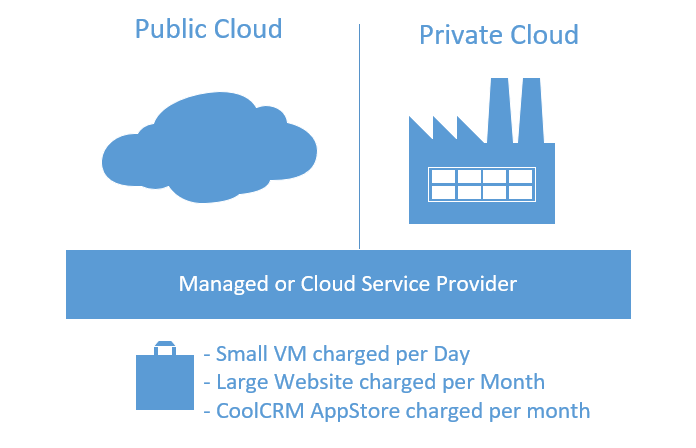
For example: with most public cloud providers, the provider defines the chargeable items that are shown on the end-of-month invoice. However, when working through a Managed Services Provider, a Cloud Services Provider, or a System Integrator, additional services can be sold on top of those. Potentially, you may want to apply an uplift to the rate or charge a fixed amount of money every month for a certain service. Different scenarios are possible here, it all depends on your business logic.
Terminology
A service is a named item with associated rates and/or costs used to calculate a charge that appears on a report, where rates represent revenue and costs represent overheads.
When discussing services and their related charges several terms are required. Exivity Core uses the following terminology in this regard:
| Term | Synonym/Abbreviation | Meaning |
|---|---|---|
| service definition | service | A template defining how service instances should be charged |
| service instance | instance | Consumption of a service, associated with a unique value such as a VM ID, a VM hostname, a resource ID or any other distinguishing field in the usage data |
| unit of consumption | unit | The consumption of 1 quantity of a service instance |
| charge interval | interval | The period of time that a unit of consumption is charged over (additional units of the same service instance consumed within the charge interval do not increase the resulting charge) |
| unit rate | rate | The charge associated with 1 unit of consumption of a service instance in the charge interval |
| COGS rate | cogs | (Short for Cost Of Goods Sold) The cost (overhead) to the provider of a service for providing 1 unit of consumption of that service per charge interval |
| charge | A generic term to indicate some money payable by the consumer of service instances to the provider of those instances |